

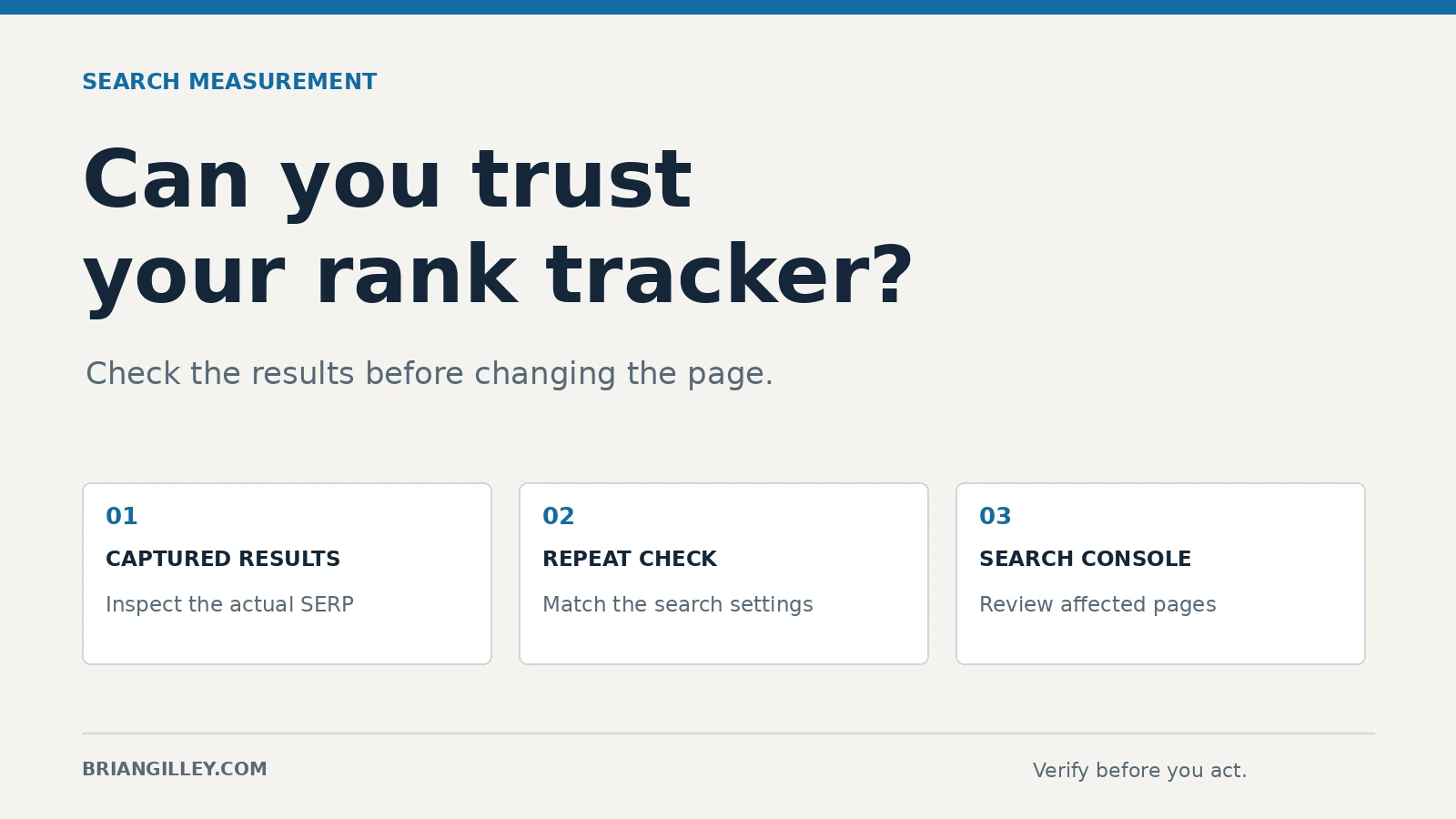
On October 10, 2026, Nozzle published research describing unusual Google results reaching automated tracking tools. The concern for SEOs is straightforward: a tool could report a ranking loss that sends you looking for website problems before you’ve checked whether the measurement is reliable. On sizable websites, this could pose lots of added stress with proper reporting.
TL;DR
- Check a sudden ranking drop before changing content or reporting a confirmed loss.
- Compare captured search results, repeat checks, and the affected pages’ Search Console performance.
- Ask your tracking provider how it identifies questionable results and corrects affected reports.
What are “poisoned” Google results?
A SERP is a search engine results page. Nozzle uses “poisoned” to describe collected results where most of a keyword’s usual websites disappear, then return on a later check.
In Nozzle’s research on poisoned Google SERPs, 8% of the 17.8 million results pages it could classify since September 13 met that definition. That percentage describes its collected customer data, not all Google searches.
One example makes the issue easy to understand. For “white label local seo,” the usual SEO vendors were replaced by results including a steakhouse and a directory of health departments. The page still looked like an ordinary Google results page.
Nozzle interprets this as Google defending against AI scraping. I would keep that explanation separate from the finding itself: the research documents unusual collected results, while Google’s intent requires additional evidence.
The problem reaches beyond your own rankings
In the discussion under Cyrus Shepard’s LinkedIn post, Ben Goodey reported unexpected Reddit, LinkedIn, and Quora results. Edward Bate described surprising changes in competitor share of voice.
Those are practitioner observations, but they raise a useful question… could questionable results influence what you think competitors are doing successfully? Yikes, this could turn planned objectives into messy “tail-chasing” real quick!
I would verify an unexpected competitor surge before recommending more forum content, changing priorities, or telling a client that another website has overtaken them. An unusual result deserves investigation. It doesn’t automatically explain every ranking change involving social sites.
What I would check before touching the website
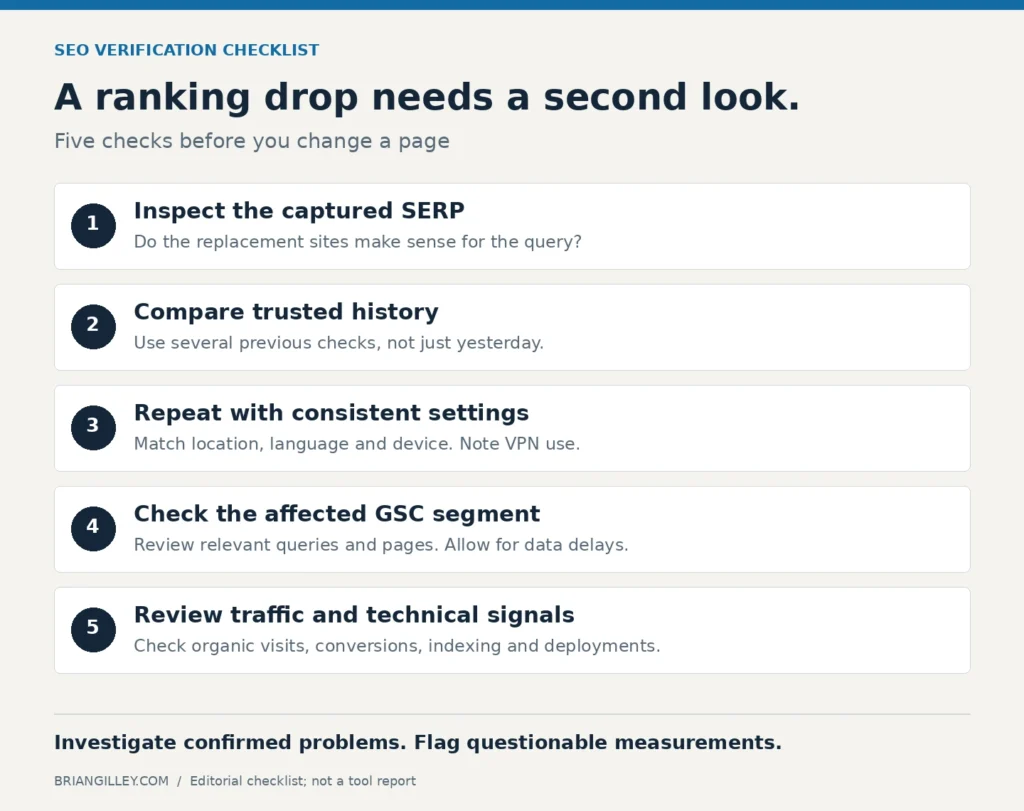
My first move would be to inspect the evidence behind the alert.
- Open the captured results. Look at the actual websites and URLs. Did familiar competitors disappear together? Do the replacements make sense for the query?
- Compare several previous checks. Yesterday’s results could also be questionable. Look for the websites that consistently appeared over the preceding weeks.
- Repeat the search carefully. Match the query, location, language, and device as closely as possible. Record whether you’re using a VPN or proxy. Incognito alone doesn’t make a search representative of every customer’s experience.
- Check the affected segment in Search Console. Review the relevant queries and pages, allowing for reporting delays. Stable sitewide impressions can hide a smaller loss.
- Look for business and technical evidence. Review Google organic landing-page traffic and conversions. If other signals support a genuine problem, investigate availability, indexing, and recent deployments.
Again, this now adds another layer of complexity and work but should be done.
Google’s guidance for investigating search traffic drops also recommends examining affected pages, queries, countries, and devices rather than relying on one overall number.
For an illustrative example, imagine a tracker reports that an important service page vanished overnight. Repeat checks still find it, and the relevant Search Console data doesn’t yet support a loss.
I would annotate the report and request another collection before assigning a rewrite. If clicks, traffic, and repeat checks also deteriorate, I would investigate immediately.
What workarounds are tracking providers describing?
SEOmonitor’s Cosmin Negrescu mentioned in the LinkedIn discussion (linked above) that its team compares questionable results with each keyword’s last trusted results and retries suspect collections. Monitorank’s Fabien Barry described comparing API results with a reference browser.
These are vendor-described approaches, not proof that either method catches every problem. Still, they give us better questions to ask:
- How do you detect unusual results that look technically valid?
- Do you retry them before publishing rankings?
- Are questionable measurements flagged?
- Will corrected data update historical reports?
I would also ask whether two tools use independent collection sources. Agreement offers less reassurance if both depend on the same underlying data.
Be specific about the AI visibility risk
A report built from scraped Google results could inherit collection problems. That doesn’t establish that ChatGPT answers or every AI visibility platform are affected.
The comments reflect that uncertainty. Pedro Da Silva asked whether the issue could influence comparisons between rankings and LLM visibility. Preston B. reported no corresponding social-source surge in the ChatGPT answers his company monitors.
I would assess AI visibility by inspecting the answers and citations a platform actually produces, then use analytics to evaluate resulting visits and conversions. Bot visits in server logs don’t prove inclusion in an answer.
Pick a few commercially important queries now. Save trusted comparisons and agree on the checks required before a ranking alert becomes a website-change request.