

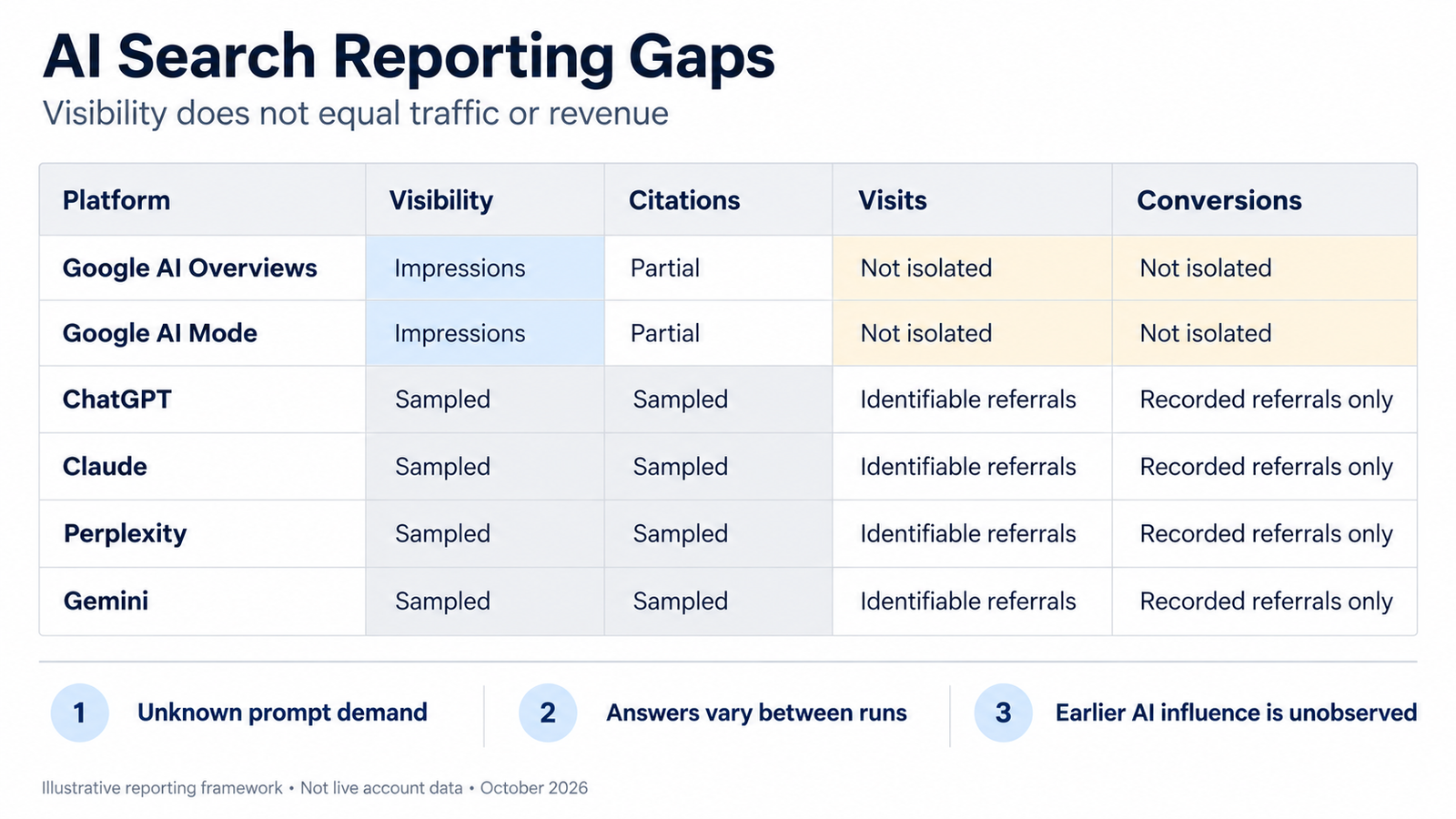
Google expanded its AI visibility reporting in 2026, and tools keep adding ways to monitor ChatGPT, Claude, Perplexity, and Gemini. But connecting an AI answer to a website visit, then to revenue, still leaves huge gaps. That makes reporting to leadership tricky when they want a clear answer about whether the work is paying off.
TL;DR
- Report AI mentions, citations, referral visits, and conversions separately. Each answers a different question.
- Prompt trackers measure sampled answers. Their scores depend on what they test and how they collect results.
- Combine platform reporting, analytics, and customer feedback. Explain the limits beside the numbers.
What does “AI visibility” actually mean?
An AI answer can name your company without recommending it. It can recommend your company while linking to a review site. It can cite your article without mentioning your brand.
Those distinctions matter:
| Metric | What it measures |
|---|---|
| Mention | Your brand appears in an answer |
| Recommendation | The answer suggests your product or company |
| Citation | The answer links to a source |
| Referral session | An identifiable AI referral brings someone to your website |
| Conversion | A recorded visitor completes a business action |
A citation to your website and a citation to someone else discussing your company should also be separate. Otherwise, “our citations increased” can hide what actually changed.
Why AI tracking methods fall short
The methods are useful, but each captures part of the picture. Eight gaps deserve attention:
- Prompt demand is uncertain. Tracking a question doesn’t establish how often customers ask it. Ahrefs explains its AI demand estimation method and why estimated volume needs careful interpretation.
- Answers change between runs. A single result makes a weak benchmark.
- Context changes answers. Location, conversation history, and follow-up questions complicate comparisons.
- Testing environments differ. Check whether your tool collects consumer-interface answers or API responses, with which models and search settings.
- First-party reporting has gaps. Available platform metrics don’t provide a complete connection between prompts, visits, and revenue.
- Later visits can obscure discovery. Someone might find you in ChatGPT, then Google your company before buying.
- Citations don’t prove endorsement. A source link isn’t evidence of a recommendation or sale.
- Methodology changes move scores. Adding prompts or changing models can alter visibility without any change to your website.
Rand Fishkin’s January 2026 research on AI recommendations found substantial variation in recommended brands and their order.
He also found a useful way forward: repeated testing can show how frequently a brand appears. Report that frequency across a defined sample, rather than treating one answer as a stable ranking.
Which tools belong in an AI search report?
Use tools according to the evidence they provide.
| Tool category | Useful for | Main limitation |
|---|---|---|
| GA4 | Identifiable AI referral sessions and conversions | Doesn’t reconstruct earlier, unobserved AI interactions |
| Google Search Console | Google AI feature impressions and visible pages | Dedicated reporting doesn’t fully connect queries, clicks, and outcomes |
| Bing Webmaster Tools | Citations and grounding context in supported experiences | Doesn’t cover every AI platform |
| AI visibility trackers | Sampled mentions, recommendations, citations, and competitors | Coverage and methodology shape the score |
| Server logs | Bot fetching and technical access | A fetch doesn’t prove a citation or human visit |
| CRM and customer surveys | Qualified outcomes and self-reported discovery | Answers can be incomplete or misremembered |
Google’s Generative AI reporting announcement says the reports reached websites worldwide by August 31, 2026. They provide impressions, pages, countries, devices, and dates. Dedicated clicks and query reporting aren’t among the listed metrics.
Suganthan Mohanadasan’s AI Mode query guide offers ways to investigate conversational searches. But a classifier or RegEx match alone doesn’t prove AI-origin traffic, and anonymized queries leave part of the picture unavailable.
Microsoft offers additional citation context. Its Bing AI visibility reporting documentation explicitly distinguishes Citation Share from traffic share or a ranking system.
Track questions buyers actually ask
Build your prompt set from sales calls, support tickets, customer interviews, and search data. Include discovery and purchase questions, not just branded prompts.
For a hypothetical CRM provider, six illustrative examples could be:
- “What CRM works best for a small landscaping company?”
- “How can I stop losing track of customer follow-ups?”
- “[Brand] vs. [competitor] for a five-person team.”
- “Which CRM costs under $100 a month?”
- “Who offers CRM setup support in Raleigh?”
- “Which of those options integrates with QuickBooks?”
Keep a fixed core set for comparisons. Track new exploratory questions separately, repeat tests, and record the platform, model, location, and date.
What should executives see?
Keep the monthly scorecard to seven metrics:
- Google AI impressions.
- Brand mention rate across monitored answers.
- Website citation rate.
- Recommendation rate.
- Competitive share of mentions, with the calculation defined.
- Identifiable AI referral sessions and conversions, split by platform.
- Qualified pipeline or revenue associated with recorded referrals and self-reported AI discovery, shown separately.
Don’t combine overlapping conversions. Add a short methodology note with prompt count, repeat runs, platforms, and collection changes.
Use precise reporting language:
- “Our mention rate increased across the monitored questions.”
- “Recorded AI referral conversions increased this month.”
- “Branded searches increased alongside AI visibility. We can’t establish how much AI caused that increase.”
Finish the report with an action: fix inaccurate answers, investigate a competitor’s stronger presence, or improve a page that earns citations but few qualified visits. Give leadership enough evidence to make that decision without claiming more than the data supports.