

Google Cloud introduced the Open Knowledge Format in June 2026, then released v0.2 on July 24 with fields for sources, verification, and freshness. I believe it’s worth exploring for organizing the knowledge behind a website, especially when important facts are scattered across multiple pages.
But I believe calling OKF a missing “AI visibility file” kind of gets ahead of the actual evidence. Read on…
TL;DR
- OKF packages knowledge as linked Markdown files with metadata. It’s a bundle of files, rather than one special SEO file.
- Tools can help create, validate, and maintain bundles, but publishing one doesn’t establish that answer engines will discover or use it.
- I’d start with a small, reviewed bundle and test whether an agent answers questions more accurately when given access to it.
What is Open Knowledge Format?
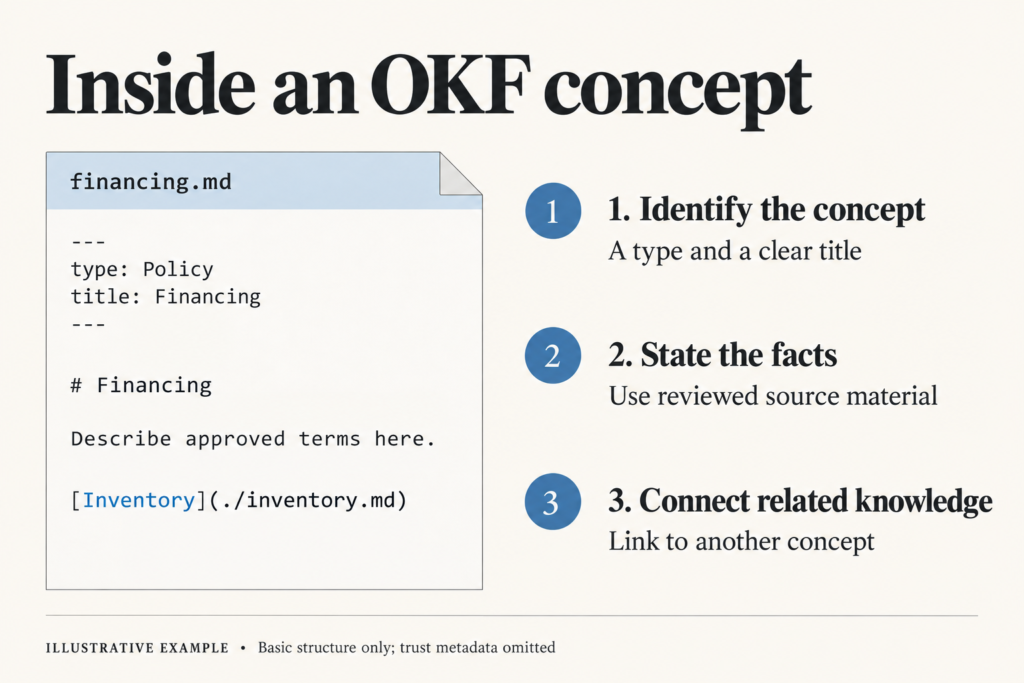
The official OKF specification describes a folder of Markdown documents, each representing a concept. A YAML metadata block identifies the concept, while ordinary Markdown links connect it to related concepts.
For a website, those concepts could include a business, service, product, location, or policy.
I wouldn’t automatically turn every URL into a separate concept. Several pages might describe the same service, while one detailed page might cover multiple concepts. Mapping URLs is a starting point. Deciding what the business actually knows takes more thought.
Here’s an illustrative example: a motorcycle dealership’s financing information might appear on its homepage, inventory pages, and financing page. A financing concept could consolidate the approved facts, identify the source page, and link to relevant products.
That organization could help an agent follow relationships without reconstructing them from scratch.
Does OKF improve AI search visibility?
I haven’t found evidence that publishing an OKF bundle produces more AI citations.
Google Cloud developing a knowledge format also doesn’t establish that Google Search uses it as a visibility signal. Google’s guidance for generative AI search says special AI text files and Markdown aren’t necessary and aren’t treated as special optimization mechanisms.
The OKF specification also leaves serving infrastructure to implementers. It doesn’t establish a universal website discovery endpoint.
My interest is more practical: can a maintained bundle help an agent distinguish current business facts from outdated or conflicting information?
That’s a question we can test.
OKF tools worth checking out
These tools serve different purposes. Some produce knowledge bundles; others help keep them usable.
| Tool | Where it fits |
|---|---|
| BrandLeap OKF Mapper | The BrandLeap OKP Mapper tool converts a Screaming Frog crawl into a website knowledge bundle. I couldn’t independently inspect the tool page, so its export and publishing behavior still need checking. |
| Google’s reference agent | The official OKF repository includes a proof-of-concept producer, sample bundles, and a graph viewer. Useful for understanding the format, though it isn’t a turnkey website exporter. |
| okf-skills | The community okf-skills toolkit supports authoring, maintenance, validation, visualization, and v0.1 migration. It also provides a GitHub Action for automated checks. |
| OpenKnowledge OKF plugin | The OpenKnowledge plugin provides editing diagnostics, project audits, agent feedback, and optional index generation. Useful for maintaining a living bundle. |
| OKF Conformance Suite | The open-source conformance suite validates v0.2 structure and reports quality warnings. It includes an agent skill for establishing and maintaining bundles. |
| Browser-based OKF Validator | The OKF Validator checks required structure, metadata guidance, missing link targets, and freshness concerns. Useful for reviewing generated output. |
I believe these tools become more useful when creation and maintenance are planned together. A quick export can become another stale copy of your website.
Three angles I’d pay closer attention to
A crawl can preserve your content problems
A crawl-based generator starts with whatever your website currently says.
If three pages disagree about service coverage, converting them into Markdown won’t resolve the disagreement. I’d use the mapping process to identify those conflicts, then correct the original pages before approving the bundle.
That gives the work value even if no public answer engine ever requests it.
Verification will need an actual owner
OKF v0.2 can record sources, verification, and freshness information. Those fields describe review activity; they don’t independently prove a claim.
I’d assign someone responsibility for reviewing changeable information, especially inventory, pricing, policies, and availability. Regenerating a file shouldn’t automatically count as verifying its contents.
Controlled agent tests offer clearer evidence
I’d give the same agent a fixed set of business questions, first with the existing material and then with the reviewed bundle.
For an illustrative dealership test, questions could cover financing conditions, supported motorcycle brands, and service locations. I’d compare factual accuracy, source identification, outdated answers, and unsupported assumptions.
How I’d start
I’d select ten important concepts, review their source pages, generate the bundle, and validate its structure. Then I’d test it with an agent explicitly given access.
If I also published it, I’d monitor server requests separately. A bot fetching a file demonstrates access. It doesn’t demonstrate that the file influenced an answer or generated a citation.
The first result I’d want is straightforward: fewer incorrect answers about the business, with a clear process for keeping those answers current.