

Google’s 2023 antitrust trial and a DOJ interview released in 2025 gave us a clearer look at how its ranking systems work. With AI answers changing how people find information, this is a good time to revisit what your pages actually deliver. The findings give us something concrete to work from, even if they don’t explain how to land an AI citation. I personally would not sleep on these core fundamentals of SEO.
TL;DR: Google’s antitrust case documented three important ranking components: Topicality, which includes Anchors, Body, and Clicks; Navboost, which uses historical user interactions; and Q*, a broader quality component. The takeaway: answer the query clearly, use descriptive links, deliver what your title promises, and improve weak content across your site. The record did not reveal signal weights or a ranking formula.
Google’s ranking systems are usually discussed through patents, leaks, and educated guesses. The antitrust case gave SEOs something more concrete: testimony and internal records from the people who built them.
Here’s what the evidence tells us and what’s worth doing about it.
What are Google’s ABC ranking signals?
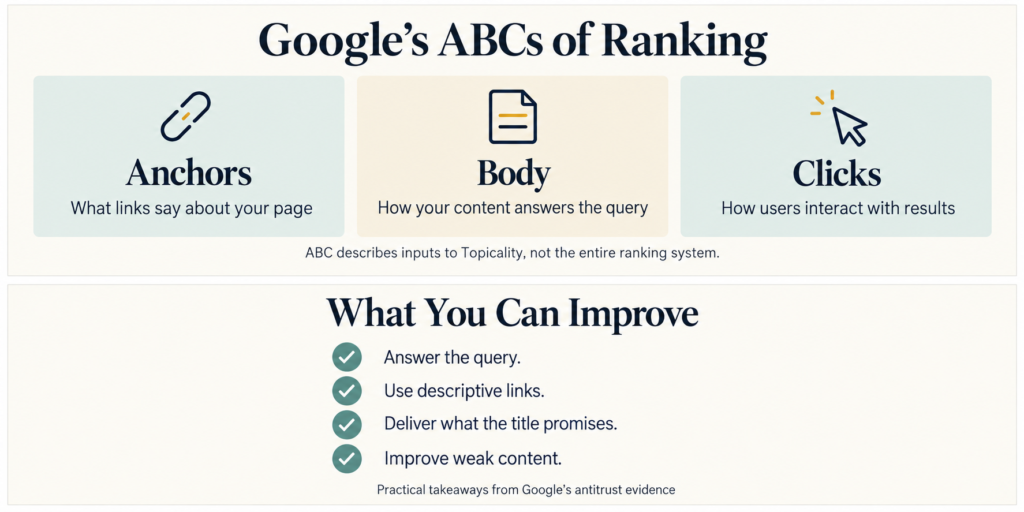
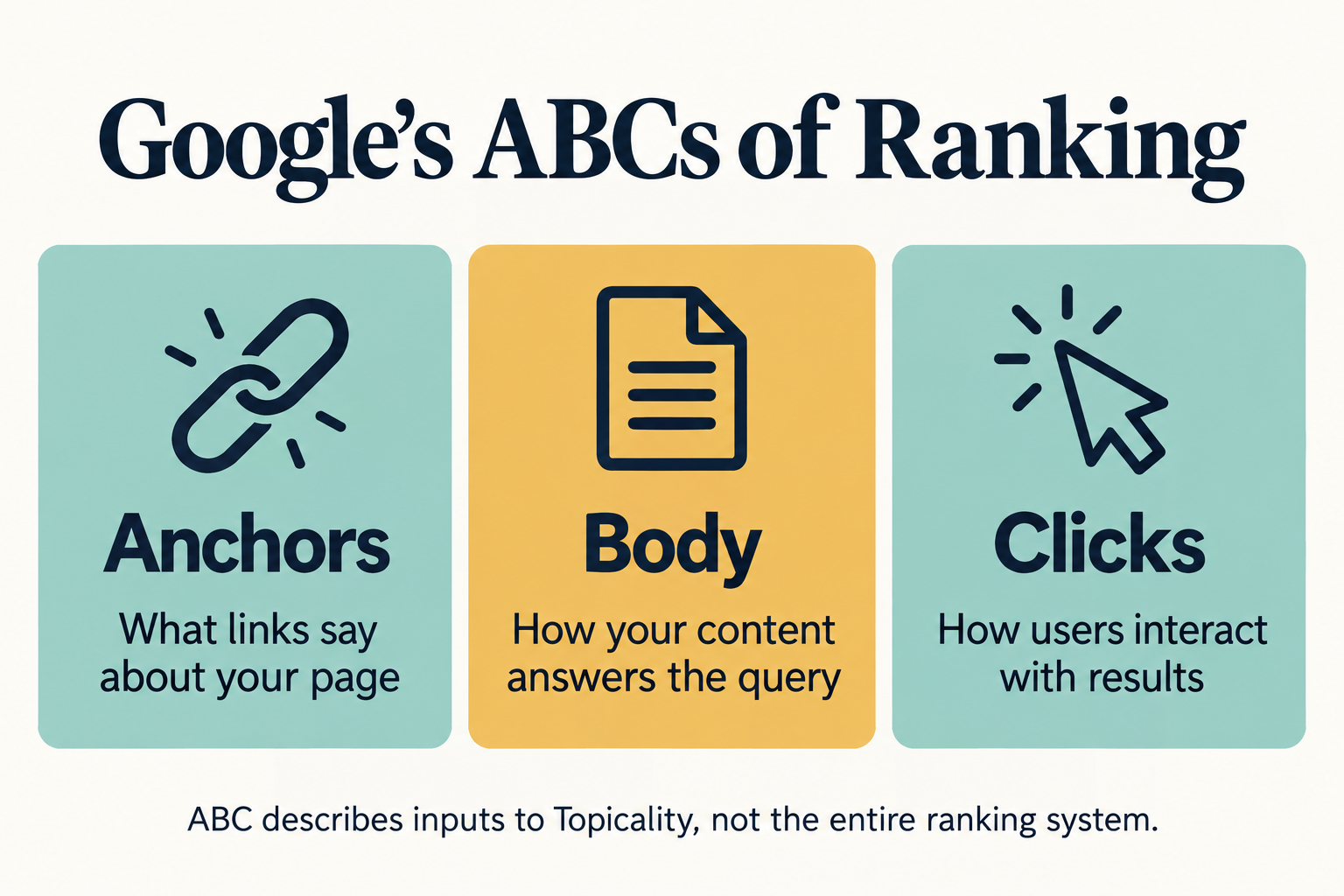
ABC stands for Anchors, Body, and Clicks. A February 2025 DOJ interview memo with Google engineer Hyung-Jin Kim describes them as fundamental inputs to Topicality, or T*:
- Anchors: What links pointing to a page say about it.
- Body: How the page’s text relates to the query.
- Clicks: How users interact with a result for a query.
ABC describes part of Google’s ranking process, not the entire system.
What to do: Answer the searcher’s actual question in your content. Use descriptive internal links. Make titles specific and accurate. These are things you can improve directly, even though you cannot see Google’s internal relevance scores.
What is Navboost?
Navboost uses historical user interactions to help rank search results. In his 2023 testimony, Google’s Pandu Nayak described a window of approximately 13 months of click data.
That confirms user behavior matters. It does not mean a higher click-through rate automatically earns better rankings or that longer visits are always better.
What to do: Put the answer early, make the page easy to scan, and deliver what the title promises. A compelling title helps only if the content is worth the visit.
Search Console does not show Navboost scores. Use clicks, impressions, and position trends to find pages worth reviewing, but don’t assume those trends reveal why rankings changed.
What is Q*?
Q* is a quality component described in the Kim memo. It includes broader quality and authority considerations that are generally independent of a specific query.
That helps explain why improving one page may not solve problems affecting the wider site. It does not prove that every weak page lowers a single domain score or that deleting content guarantees a recovery.
What to do: Review thin, outdated, inaccurate, and overlapping content. Improve useful pages, merge duplicates, and remove content that no longer serves a purpose. Strengthen sourcing and relevant author or business information.
The goal is a better site, not fewer pages for the sake of it.
What should SEOs prioritize?
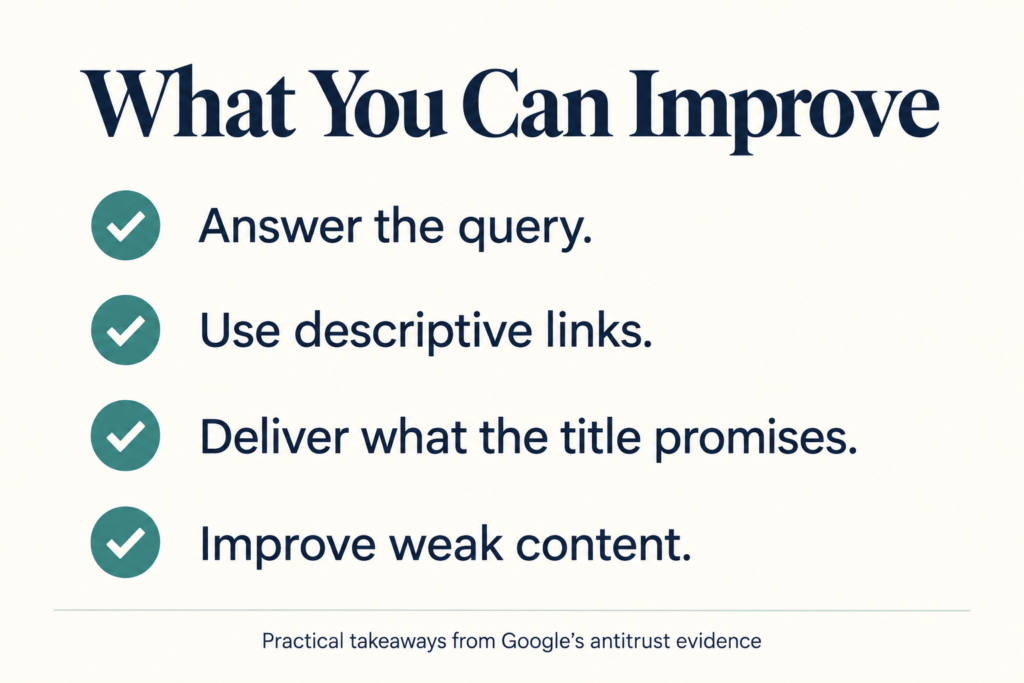
You don’t need a new strategy for every system name. Start with these four checks:
- Does the page answer the query? Give the answer near the top, then provide the detail readers need.
- Do links describe the destination? Replace vague internal anchors with useful descriptions.
- Does the page deliver what the title promises? Fix missing information and layouts that get in the way.
- Is the surrounding site useful and credible? Address recurring content problems, not just individual pages.
These practices also make content easier for AI systems to interpret and retrieve. The trial evidence does not establish a formula for earning AI citations.
The biggest finding wasn’t a secret ranking trick. It was confirmation that relevance, links, user interactions, and quality matter. Spend your time improving those instead of chasing scores Google doesn’t expose.
Sources
- DOJ interview memo with HJ Kim, Feb. 18, 2025, Exhibit PXR0356: https://www.justice.gov/atr/media/1398871/dl
- Search Engine Land, Pandu Nayak’s ranking testimony: https://searchengineland.com/how-google-search-ranking-works-pandu-nayak-435395
- Search Engine Land, Google’s ABC ranking signals: https://searchengineland.com/google-abc-ranking-signals-455360
- AJ Kohn, analysis and testimony PDF: https://www.blindfiveyearold.com/what-pandu-nayak-taught-me-about-seo
- Search Engine Journal, Google ranking systems discussion: https://www.searchenginejournal.com/googlers-deposition-offers-view-of-googles-ranking-systems/546901/