

Google’s helpful-content guidance, last updated October 5, 2026, puts content effort and deceptive author profiles firmly in view. That documentation date doesn’t establish a new algorithm rollout. It does give content teams a useful reason to revisit what their pages actually contribute.
TL;DR
- Content effort includes human work on the content and the systems powering it. Hours spent don’t automatically make a page useful.
- Publish evidence that helps readers decide or act: testing, specific observations, working tools, and clear explanations of limitations.
- Leaked effort fields are interesting context. They don’t reveal a current ranking formula or a score you can reliably optimize.
What Google actually means by content effort
Cyrus Shepard’s analysis of content effort makes a practical point: the useful work needs to show up in the finished page. Your production schedule isn’t something readers can use.
But saying effort has nothing to do with work takes that argument too far. Google’s Search Quality Rater Guidelines explicitly include human work, whether it goes into creating content or building the systems behind it.
Effort also sits alongside originality, skill, and accuracy. An elaborate page can still be wrong. A short answer can satisfy the reader completely.
My practical takeaway: assess the contribution before counting the words. A detailed explanation earns its length when those details help someone complete a task. A long introduction about why the topic matters usually needs a harder look.
What the leaked effort fields tell us
Shepard highlights two fields in leaked Google documentation: contentEffort, described as an LLM-based effort estimate for article pages, and ugcDiscussionEffortScore, associated with user-generated content quality.
Those names help explain why SEOs are interested. They don’t tell us how Google uses either field today, how much weight it receives, or how it interacts with other signals. Cyrus acknowledges that uncertainty in his referenced article above.
Google also explains in its guidance on quality raters that their ratings aren’t used directly in ranking algorithms. A rater’s assessment, a documented field, and a live ranking decision are different things.
Use the published guidance to improve pages. Treat claims about a measurable Google effort score cautiously.
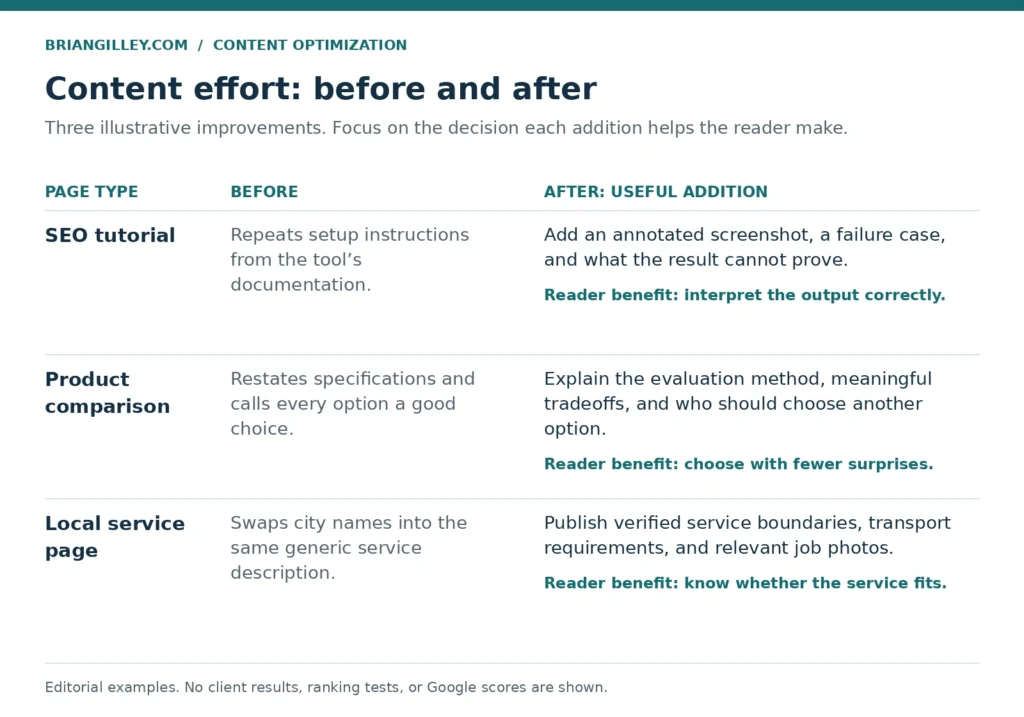
Three before-and-after improvements that add useful information
The following are illustrative examples, not client results or ranking experiments. Each shows how a page could contribute more without turning into a longer version of the same article.
1. An SEO tutorial: show where the process breaks
Before: A tutorial explains how to apply a filter and export a report. The instructions largely repeat the tool’s documentation.
After: Keep the setup concise, then add an annotated screenshot, a representative match, a non-match, and a limitation that affects interpretation.
For example, a guide to conversational Search Console queries could explain that question-shaped searches don’t establish AI-origin traffic. Show what the filter finds and what it cannot prove.
That distinction gives readers something useful to carry into their reporting. Another paragraph defining conversational search wouldn’t solve the same problem.
2. A product comparison: explain the tradeoff
Before: A comparison repeats manufacturer specifications and calls every product a great option.
After: Document how products were evaluated, which conditions affected the results, and which buyer should choose something else.
Google’s review-writing guidance specifically encourages evidence of experience, measurements, and explanations of meaningful differences.
For a motorcycle comparison, publish actual ride observations only if someone performed the rides. Otherwise, compare verified specifications and clearly label the comparison as research-based. Explain how weight, maintenance requirements, or configuration could affect the buyer’s choice without pretending those conclusions came from testing.
The useful addition is a reasoned decision. A photograph supports it when the image shows the feature or condition being discussed.
3. A local service page: answer the logistical questions
Before: Several pages promise quality service, with a different city name in each heading.
After: Add verified service boundaries, pickup requirements, relevant job photos, and what customers should provide before requesting an estimate.
A powersports service page could explain whether the shop accepts a particular vehicle type, whether customers need to arrange transport, and which photos help assess the request.
Those details can prevent a wasted call or visit. Publish them where they apply, rather than duplicating them across city pages to make each one look substantial.
Useful effort can live in a tool
A content audit that only reviews paragraphs can miss a page’s main contribution. Google’s rater guidelines also recognize effort invested in functionality and supporting systems.
Consider a comparison tool that lets buyers filter actual inventory by price and vehicle type. Its usefulness depends on accurate inputs, sensible filters, and maintained availability. Adding 800 words below it won’t repair stale inventory.
For that page, the better content investment might be clearer specifications, more reliable data, or a filter people actually need.
This changes the brief. Before assigning another article, ask whether the reader needs an explanation, a calculation, a comparison, or a current answer from your database.
Original analysis doesn’t require a private database
Exclusive data helps, but useful analysis can also come from public sources. The contribution is the comparison or judgment you make, supported by a transparent method.
For example, compare two official documents, identify where their scope differs, and explain the practical consequence. Include enough context for readers to check your reasoning.
For this topic, one useful distinction is that a page can demonstrate substantial effort through its functionality while containing very little text. That gives teams a reason to inspect tools and data maintenance alongside articles.
Keep opinions accountable. Explain the evidence, the reasoning, and where the conclusion stops applying. A strong opinion without support is still just an assertion.
Automation needs useful inputs and ongoing oversight
Automation can distribute maintained product information or organize contributions people genuinely made. The editorial questions remain: are the inputs trustworthy, does the output help, and who catches errors?
Google’s scaled-content-abuse policy targets large amounts of unoriginal content created primarily to manipulate rankings, regardless of production method.
Check both the process and the output. A reliable template can still produce an empty page when its underlying data is missing.
For AI search, Google’s AI features guidance says existing SEO best practices remain relevant and no special additional optimization is required. Useful evidence is a sensible investment, but it doesn’t guarantee an AI citation.
Audit the evidence before commissioning a rewrite
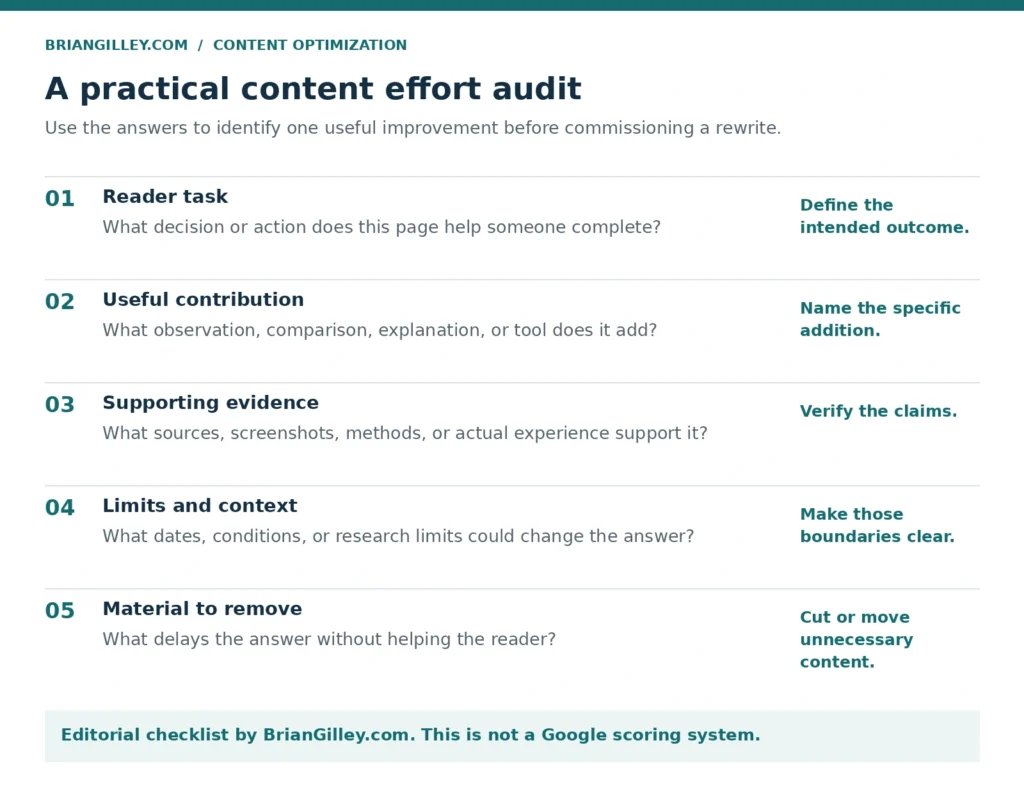
Use these five questions as an editorial check, not a Google scoring system:
- What task does the page complete? Name the decision or action it supports.
- What useful contribution does it add? Identify the observation, comparison, explanation, or functionality.
- What supports the claims? Check sources, screenshots, methods, and actual experience.
- What could mislead someone? Clarify limitations, dates, and whether recommendations come from testing or research.
- What can you remove? Cut material that delays the answer without helping the reader.
Then update the brief. Replace “write 1,500 words” with a specific request for the missing contribution: a documented failure case, a verified service limitation, or an explanation of a real tradeoff.
Choose one important page. Find the question it leaves unanswered, gather the evidence, and put the answer where readers can use it.