

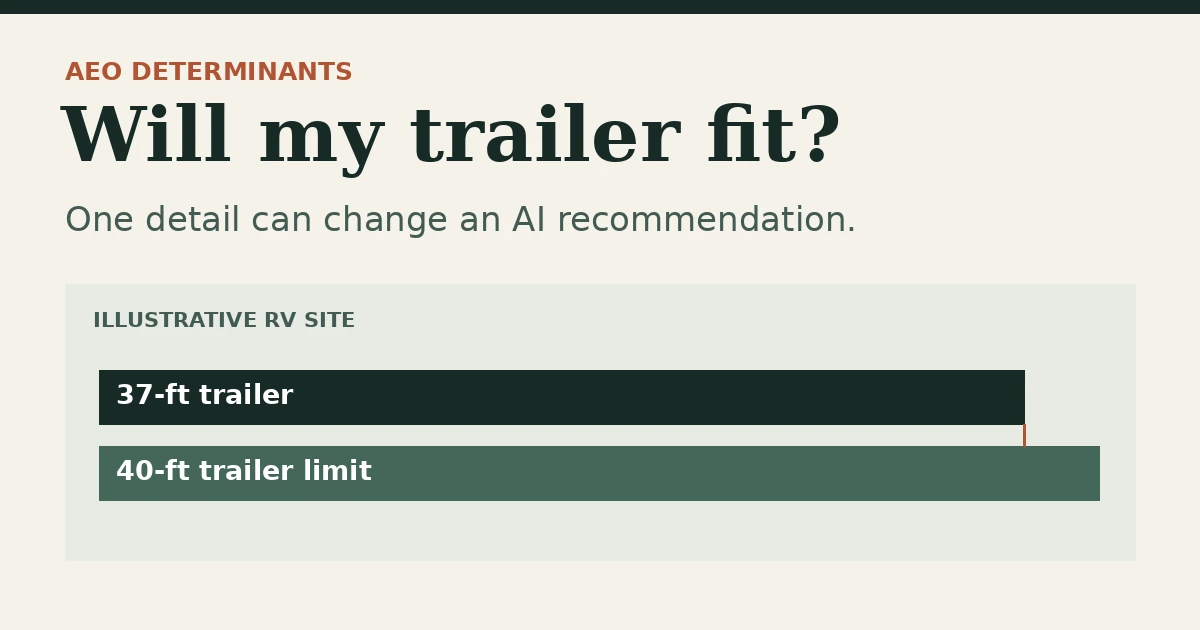
Ask ChatGPT for an RV park near Boone twice and you may get two different lists. Add “I’m towing a 37-foot trailer and need a pull-through site,” and now there’s a concrete reason to rule out some of those parks. That’s the part of answer engine optimization (AEO) I’d build into a campground site.
The quick Q&A
What’s a determinant? A detail that could change the recommendation. A 37-foot trailer has to fit. Full hookups might be a preference, or they might be a deal-breaker.
Where do I find those details? Start with the specific wording people use in Google Search Console (GSC). Check recurring requirements against your site’s filters, booking data, or customer questions.
What should I change first? Fix the page that should answer the question. If a filter says “big-rig friendly,” put the verified length limit on the listing and explain what that limit measures.
Why I’d track prompts and brief pages differently
I’d keep a small, fixed set of prompts to see which businesses and pages come up over time. For deciding what to publish, I’d look for requirements that survive a change in wording. “Will my camper fit?” and “RV parks near Boone with 40-foot pull-through sites” can point to the same missing fact.
In November 2026, Jimmy Park and Tobias Peschke’s Opascope research reported that 94.4% of the coded ChatGPT answers mentioned at least two of their five determinants. The agency drew from its own client accounts across categories, including B2B and e-commerce. The study counted what appeared in answers. It leaves open what actually changed the recommendations, how well the sample represents local search, and whether other AI platforms behave similarly.
| Determinant | Payroll software (example) | Campground (example) |
|---|---|---|
| Audience | A five-person business | A family camping with kids |
| Use case | Paying contractors in two states | Towing a 37-foot trailer |
| Selection criteria | Tax filing included in the price | Pull-through site with full hookups |
| Credibility | Independent reviews of support | Recent reviews describing whether the turns are tight |
| Brand association | A provider repeatedly associated with payroll | A booking site regularly mentioned in camping guides |
For local and marketplace sites, I’d give location and availability their own columns. A park can meet every equipment requirement and still be too far away or fully booked for the dates you need. For brand association, I’d look at independent coverage and accurate listings across platforms before adding another claim to my own page.
Find the requirements in Search Console
Start with 90 days in your main market. In the Performance report, use a custom query regex to sample searches with nine or more whitespace-separated terms. Use the Search Analytics API if you need page and query together at scale. Google can still return only a subset of rows.
^(\S+\s+){8,}\S+$Nine words is a starting point. “Boone RV parks 40 ft pull through” is shorter and still tells you exactly what someone needs. Tag each query with every requirement it contains, group the results by page type, and use impressions as a rough guide to where to look first. Internal filter use can help confirm a pattern that appears only a handful of times in GSC.
Flag search operators like site:, prompt fragments, and identical questions repeated across dozens of cities. Set aside clearly irrelevant rows and review repeated patterns before counting them as demand. A genuine shopper can write a long query or search for the same brand several ways. Google’s explanation of query fan-out describes how AI Mode can run several related searches from one question. Wording alone can’t tell you who or what generated a particular GSC row.
Test one requirement and fix one template
- Pick 20 questions. Spread them across listings, location pages, and guides. Include broad questions that leave room for follow-ups and specific ones that give the assistant enough to recommend something.
- Run each twice in fresh chats. Keep the model, search mode, and location consistent. In a sheet, record the prompt, date, model, follow-up questions, recommendations, and cited URLs. If it recommends something straight away, record which requirements the answer mentions.
- Change one thing in a follow-up test. Try the same Boone prompt with a 25-foot trailer and a 37-foot trailer. Keep the dates and hookup requirements fixed. Check whether the suggested listings actually fit. Repeat a few prompts on a second platform before drawing conclusions across engines.
- Audit the pages. Mark each requirement as clear on the page, available only in a field or filter, or missing. Start with a gap your search data, customer questions, or booking behavior also supports.
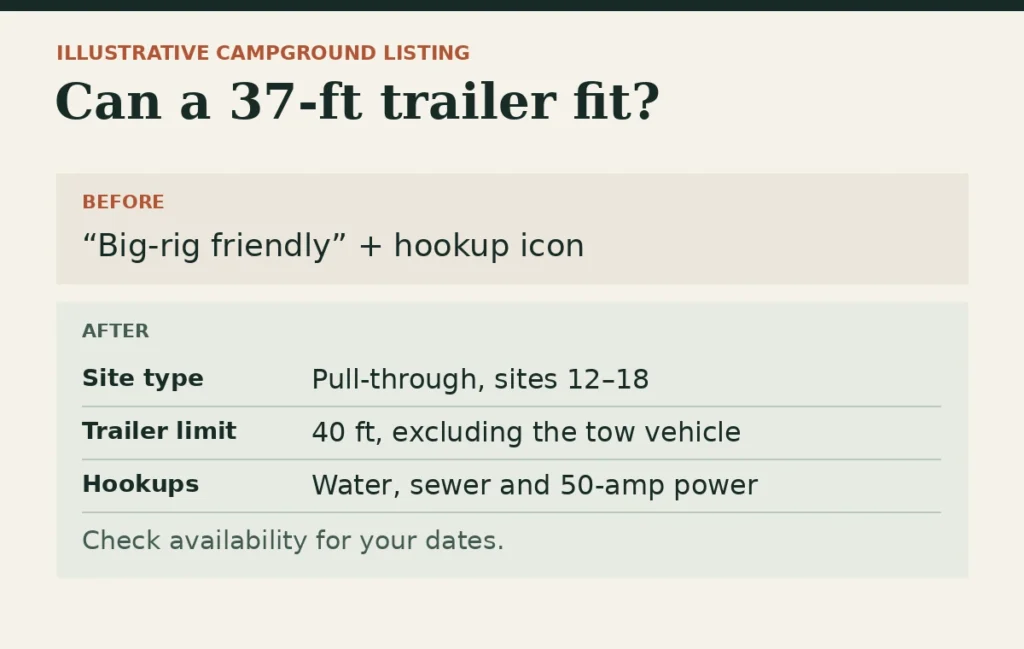
Here’s an illustrative listing edit with visual illustration above:
Before: “Big-rig friendly” and a hookup icon.
After: “Sites 12–18 are pull-through and accept trailers up to 40 feet long, excluding the tow vehicle. Each has water, sewer, and 50-amp power. Check availability for your dates.“
On the location page, let people compare verified length limits, fees, and hookup types side by side. In a guide, explain the trade-off between two parks and link to the listings where people can confirm current details.
Measure visibility and bookings separately
Re-run the same questions in 60 to 90 days. If you can, leave a comparable group of pages unchanged and account for seasonal demand. Google’s generative AI report shows page-level impression trends without a query breakdown. Bing’s AI Performance report shows citations and phrases used to retrieve sources. Use GA4 to check identifiable AI referrals and booking conversions separately.
I’d start with the question that can cost someone a reservation. If visitors have to call to find out whether their rig fits, put the verified answer where they book.